Passionate about art since he was a child, he thirsts for originality, uniqueness and style in what he creates. Mature familiarity in the use of “materials”, undertaking a path of personal study, analyzes the movements of what surrounds him, rationalizing new artistic hypotheses; distinguishing between the lines the one who frees his “I”. He loves to discover, evaluate and explore new artistic techniques, many of which are outside the canonical patterns and production methods. Nothing is planned, because from his point of view “the originality with which a work is made gives the work itself the ability to express itself”. He is particularly attracted to the “Sacred”, where he finds his greatest inspiration. His works are never “forecast”, he never creates any “sketch or reference”, everything is born in the moment, “develop in that instant or lose everything”. In his creations he often chooses and marries different elements, enhancing the best of each, setting them in a harmonious language. The cornerstone of his “style” is “artistic idealism”, the inspiration of the moment, considering matter as something secondary compared to “the idea” that is, the spiritual substance that it can express. He acquires notoriety thanks to his wife Paola, who promotes his art, convinced of the talent expressed in his works, stubborn, insists on making them public despite the “contrary” opinion of the Artist, to any form of media and so that the perseverance of Paola is rewarded; organizes the first artistic event on 9 August 2012, on the occasion of a collective art exhibition, entitled “Angoli D’arte” in Angoli (CZ). It is precisely in this event, which confirms his wife’s conviction, in fact, Mazza’s art wins the applause of the public, receiving flattering appreciation.
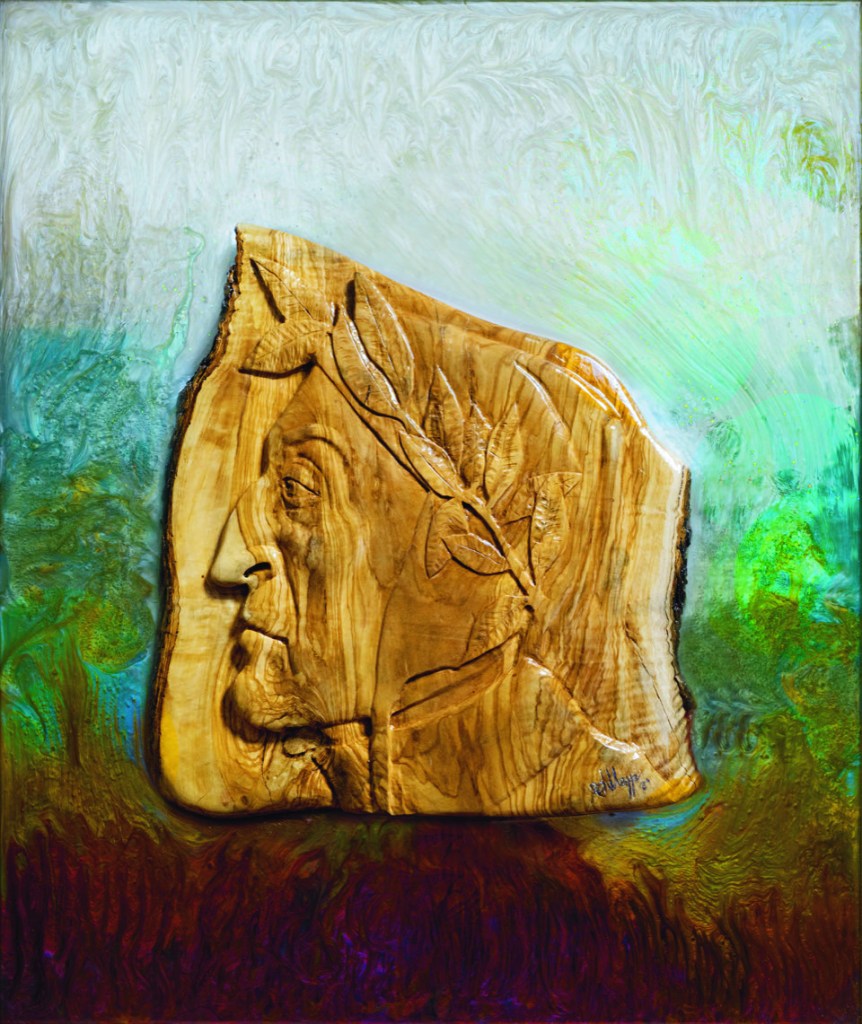
A long series of public events followed with great satisfaction “enriched” by an escalation of prizes and recognitions. Unique and exciting are the meetings with the Supreme Pontiff His Holiness Pope Francis, to whom Mazza had the honor and privilege of designing, creating and donating four singular works, in four separate meetings. Of particular relevance is the “spirit” with which Mazza lives his artistic life, he is deeply convinced that his art is a “gift” and as such must be “donated”, with the hope that it can arouse emotions and at the same time develop and raise awareness through the free transfer of some of his masterpieces, the collection of funds through “voluntary donations” to be donated entirely to charitable works and in support of medical and scientific research. He has made over 40 donations, including monumental works, paintings and sculptures, donated to museums, religious, civil and military bodies and authorities. Recognized with more than 190 national and international awards including prizes, honors, merits, certificates and 90 publications and video reviews, in magazines, websites and authoritative art catalogues, which describe his art. He has exhibited in prestigious national and international museums, in the main Italian cities and in 17 foreign countries: Hungary, Malta, Spain, France, Portugal, Greece, Russia, California, New York, England, the Principality of Monaco, Florida, Belgium, the Vatican State , United Arab Emirates, Austria, Germany.
The following have written about him and given him recognition: Philippe Daverio, Vittorio Sgarbi, Paolo Levi, Lorella Cuccarini, Roberta Camerino, Luca Cantore D’Amore, Daniele Radini Tedeschi, Rotary Club Lamezia Terme, Jean Blanchaert, Marco Galdi, Alessandro Masi, Anna Mondavio, Barbara Benedetti, Alberto D’Anastasio, Veronica Ferretti, Luigino Rossi, Marco Rebuzzi, Fondazione Costanza, Calogero Cordaro, Federico Caloi, Veronica Nicoli, Costantino Mazzanobile, Salvo Nugnes,
Vincenzo Abati, Isca Sullo Ionio Municipal Administration, Minimi Fathers (San Francesco di Paola), Carla d’Aquino Mineo, Armando Principe, Sandro Serradifalco, Mattia Carlin, Maria Emilia Ciannavei, Franco Margari, Cristina Cattaneo, Silvio Siciliano, Luigi Cerruti, Administration Municipal of Falerna Marina, Lorella Pagnucco Salvemini, Rita Salci, Giuseppe De Luca, Fulvia Minetti, Annacarla Merone, Elena Gradini, Guido Folco, Isabella Fortunato (IFF), Flavio De Gregorio, Licia Oddo, Eugenio Giani, Mariarosaria Belgiovine, Flavia Abati, Rosanna Chetta, International Police Association (IPA) Italian Section XVII Calabria delegation, Accademia Arte nel Mondo, Lodovico Gierut, Maria Grazia Todaro, Municipal Administration of Lamezia Terme, Rosario Sprovieri, Caterina Grifoni, Maria Rita Parsi, Giuseppe La Bruna. Describing him in the various critical notes, as an eclectic artist with a Renaissance artistic spirit and creativity? boundless, which also inherits from the Impressionist artists the ability to harness emotions onto a surface. Mazza shares with the great artists of the past, first of all, his training which took place when he was still a child admiring Uncle Gaspare, a sculptor-painter from Lamezia Terme, and his great passion for the material.
It has been defined as a “narrative intent”, which perseveres in continuous expressive research without settling entirely into a single stylistic setting capable of making it recognizable and equally predictable. Osserva processes and creates artistic testimonies free from any aesthetic requirement, never adulterated. As genuine as spontaneity, as dismay or mystical transcendence. Synthesis of an original creative process made of experimentation and discovery of techniques and styles, of lightning-fast and captivating inspiration, of combination of elements and matter subservient to the idea. His works are in fact the result of internal movements which, through an instinctive juxtaposition of elements dictated by the sensations of the moment, tend to produce as many pulsations in the final fruition. In front of these works the observer is attracted by the ghostly character of the compositional whole, but is also induced to reflect on the desires and emotions, and on the fears and dreams that urge the human soul to cross the border of the unknown, in search of knowledge. Even though the work of art is made of matter, it cannot stop only at the latter. Let’s take for example the homage to one’s native land “Lamezia Terme”, here the idea of representation prevails over the canonical rules of perspective. Al Mazza is not interested in showing the tower of his city, its beauty, according to the usual norms, he is interested in communicating his state of mind, showing us how he feels about those places where he was born, where he lived, where he still works, creates , exists. And in this he recalls Van Gogh for that way of painting natural data filtering with his own intellectual and emotional vision. Mazza’s works are inspired by an authentic vocation to transcendence by a yearning that translates into visual experience the love of an infinitely great God, who guides man on the path of salvation. Prof. Cantore D’amore together with Prof. Philippe Daverio, admiring the work entitled “Figlio Mio”, thought it was provocative and insinuating to compare it to the “Lamentation over the Dead Christ” by Niccolò dell’Arca. So can we reflect on how different the methods are? of expression 500 years later, of pain. Stating precisely how the contemporary expressed by Mazza is a provocative contrast of values and techniques, ancient and contemporary, they are like the silent song of a soul that rises to touch the unknown to grasp the sense of the divine, inspired by the state of grace that pervades all his inspiration.
 Waves and runways